Three careers before this one
Steve Hurwitz's résumé doesn't read like anyone else's. Thirty years in IT — he was already working full time in a data center his senior year of high school. Seven years as a fitness professional and competitive bodybuilder. Four years as the senior animal wrangler on a Las Vegas wildlife show. Three very different industries with the same job underneath: complicated systems, real consequences for winging it, and showing up when you say you will.
That last part matters more than it sounds. Most of what frustrates people about RV service isn't the wrenching — it's the business around it: nobody calls back, nobody shows up in the window, nobody explains what they're about to charge you for. Thirty years of keeping systems running is reasonable preparation for fixing that.
Then COVID closed the wildlife show for good. Steve owned an RV, watched the industry explode with first-time owners, and did the math: millions of rigs on the road and nowhere near enough people who can fix them — and he knew he could. So he sold the house and headed to the National RV Training Academy in Athens, Texas.
He trained for this — properly
The standard Certified RV Technician program is five weeks. Steve took ten. Then two more weeks to certify as an RV Inspector. Then a week on solar. Then a week on generators. And when Lippert came to the academy, a week with them for factory certification on systems like leveling and slides. Three months in all — because "certified" was the floor he was aiming for, not the ceiling.
Today Steve is a Certified RV Technician and a member of the Recreational Vehicle Technician Association of America (RVTAA), with over 500 hours of formal education and more than a dozen certifications behind him. He works with, and is recognized by, most major RV brands.
Eight of those certifications are system-specific NRVTA credentials — water heaters, furnaces, refrigerators, air conditioners, leveling, slides, solar and generators. Several more matter a great deal if you own a particular kind of coach:
- Truma Level III Technician & Premier Partner Dealer — the top service tier, and we're not aware of another mobile Truma-certified tech within roughly 250 miles.
- Aqua-Hot Certified — hydronic heating, including the Oasis systems in most Newmar coaches.
- Lippert Certified — the components underneath a huge share of modern rigs, Kwikee steps included.
- State of Nevada LP Certification for RVs — a state license, not a brand course. Few mobile techs in the valley hold it.
See the full credential list →
House side, not truck side
TekRV services everything that makes an RV livable — air conditioning, refrigerators, water heaters, furnaces, plumbing, 12V and 120V electrical, slides, leveling, awnings and propane. Engines, transmissions, brakes and tires are chassis work, and we don't touch them. Call anyway if that's what you've got; you'll get pointed at a shop worth using. What we do and don't service →
The truck has a name
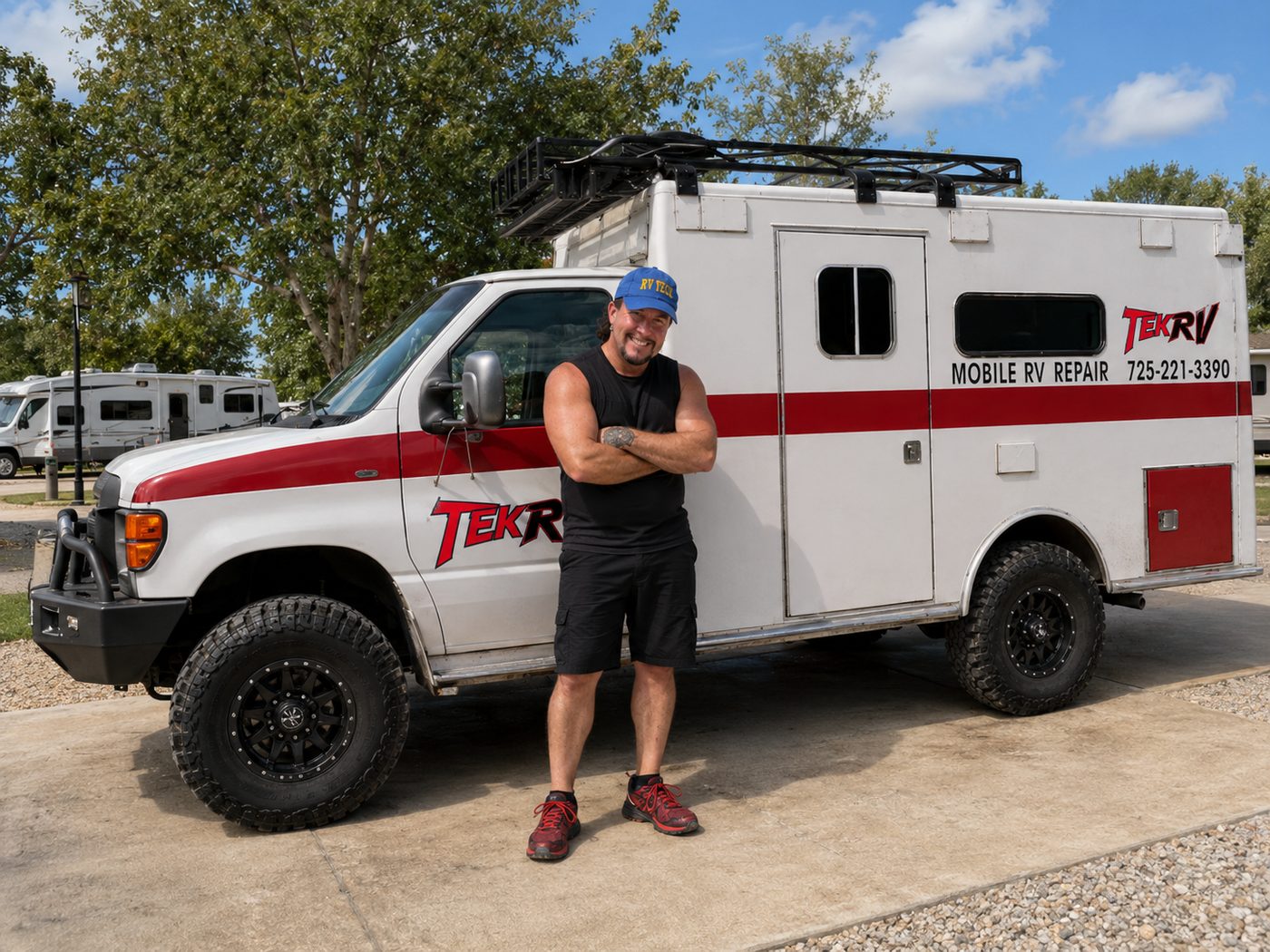
That's Alice — a retired ambulance, four-wheel drive, rebuilt into a fully-stocked mobile RV shop after five years of working out of a dually pickup. Ambulances are built to carry heavy equipment over bad roads and keep it organized, which describes the job almost exactly. If you're at a park in the valley long enough, you'll recognize her before you recognize Steve.
When he isn't under a rig
Advanced SCUBA diver, hiker, mountain biker, zip-liner, Harley rider, and a reasonably unapologetic adrenaline junkie. The common thread with the day job is that he actually uses the outdoors his customers are trying to get out into.
Seen elsewhere
Need a certified tech at your site?
Weekdays 9–5 by appointment. Text anytime — including evenings if you're stuck.